
Laundry rooms need to withstand constant moisture, heavy appliances, high foot traffic, and lots of dust from lint traps. Keeping your laundry room clean can feel like a constant chore, but having the right materials makes it easier to maintain your space.
Tiling your laundry room is a great way to make your space more durable and easier to keep clean. In this article, we’ll explore how to choose laundry room tile that holds up to real-world wear and tear while making your space both beautiful and functional.
Looking for tile that will make your laundry room feel clean and polished? Tile X Design has hundreds of tile options in a wide selection of sizes, colors, and finishes to elevate your laundry room.
How to Choose Laundry Room Tile
Tile is ideal for laundry rooms because it’s durable, easy to clean, and offers unmatched water resistance. However, some types of tile are more suitable than others. When choosing laundry room tiles, you’ll want to look for options that can handle moisture, weight, and frequent cleaning.
Porcelain and ceramic tiles both offer benefits for laundry rooms.
Porcelain Tile
Porcelain is ideal for laundry room floor tile because it is durable enough to handle heavy appliances and vibration from washing machines. It is also extremely dense, which makes it great for protecting against spills and leaks from washing machines.
Ceramic Tile
Ceramic is a more cost-effective option for laundry rooms. Because it is less dense than porcelain, ceramic tile is less water-resistant. However, it is still a great choice for a laundry room tile backsplash or flooring.
Slip Resistance & Safety
Whether you choose ceramic or porcelain tile, it’s important to consider the texture. For flooring, look at options with a matte finish or textured surface to prevent slipping hazards. High-gloss or polished tile isn’t a strong option for laundry room floors, where it’s common to have spills or moisture.
However, tiles with a gloss finish are ideal for backsplashes. Smooth surfaces are much less likely to attract dust and lint, and are easier to wipe down and keep clean.
Best Tile Sizes and Layouts for Laundry Rooms
The size of your tile also affects how easy it is to clean and maintain. For flooring, tile between 12 and 24 inches is the most common size. Medium to large format tile has fewer grout lines, but the size is still durable enough to withstand heavy washers and dryers.
For drain areas, you will want to use smaller tiles that allow you to create the necessary slope for proper drainage. Mosaic tile or other small-format options are easiest to use in drain areas.
When it comes to layouts, simple is better. Straight or offset layouts are efficient to install, and they create a clean, functional look. Not only that, tile arranged in straight lines is generally easier to clean compared to herringbone or diagonal layouts.
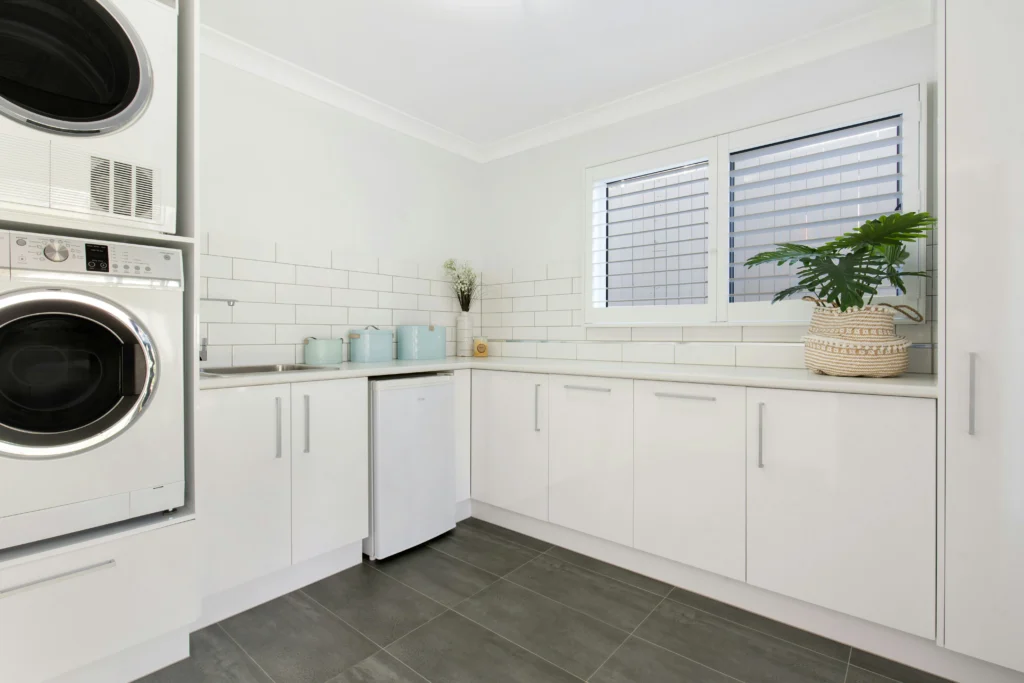
Laundry Room Tile Design Tips
Your laundry room might be a utility space, but that doesn’t mean it has to be boring. Using a thoughtful tile design makes the space feel more inviting while also integrating with the rest of your home. Here are some design tips to keep in mind:
- Dark tile will show lint, dust, and pet hair more easily than mid-tone colors.
- As a high-traffic area, you may want to use dark or mid-tone grout instead of light colored grout.
- Using patterned tile is great for hiding the look of dust and debris between cleanings.
- Create visual interest by using different colors of tile for your backsplash and floor.
- Choose colors and patterns that coordinate with adjacent rooms.
- To make the room more inviting, consider using in-floor heat.
Tile Installation Tips for Laundry Rooms
Proper installation is just as important as choosing colors, patterns, and sizes that work for your space.
- Subfloor Prep. Laundry appliances concentrate a lot of weight into a relatively small space, and they can cause vibrations during spin cycles. If the subfloor is uneven or poorly supported, the weight and movement can cause cracked tiles or chipped grout.
- Waterproofing. Building codes don’t require laundry rooms to be waterproofed like walk-in showers. However, given the possibility of leaks, it’s a good idea to include a waterproof membrane to protect your floors and lower walls before installing tile.
- Space Planning. Laundry rooms can be tight spaces. Make sure the thickness of your tile still gives you enough clearance to move your washer and dryer for servicing and deep cleaning. If your washer sits beneath a counter or is inside a closet, take the tile thickness into consideration.
Elevate Your Laundry Room with Tile X Design
Laundry rooms don’t have to be uninspiring, utilitarian spaces. By combining beautiful colors and patterns with easy-to-clean finishes, you can turn your laundry room into the space you’ve always wanted it to be.
Wondering where to start? Visit our Plymouth showroom to see our tile options in person or contact our team for expert assistance in choosing the perfect tile.